
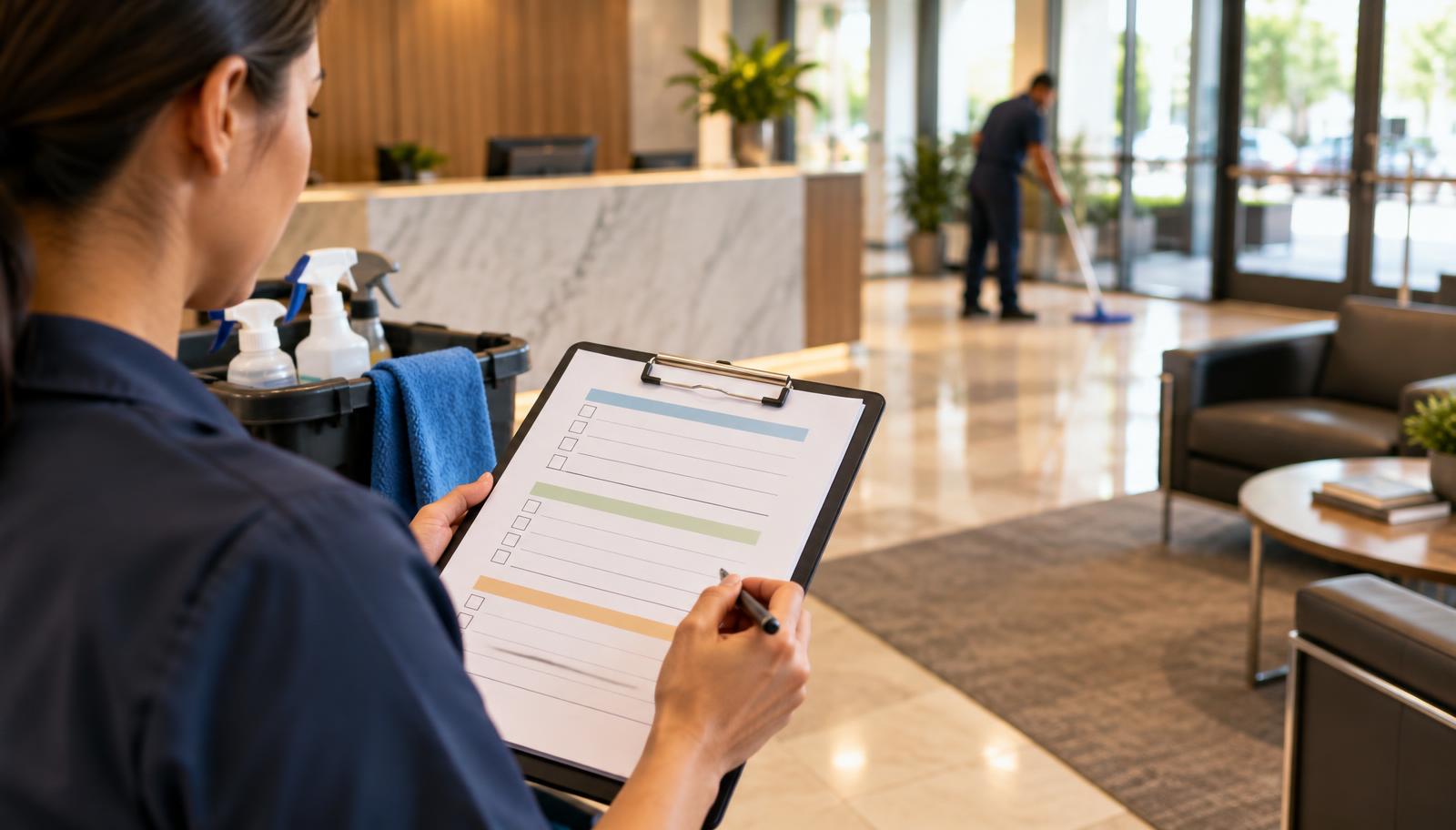
Use this office cleaning checklist as a task schedule, not as a generic list of everything a cleaner could do. Assign each item at the contracted frequency, by zone, and give the crew a clear completion record for every visit.
The daily, weekly, and monthly frequencies below are starting points only. Match them to the signed scope of work, the building’s use, and occupancy; they are not industry standards. Confirm the agreed frequencies, included areas, exclusions, and client-provided supplies against the Commercial Cleaning Scope of Work Checklist: 12 Items to Confirm Before You Send the Proposal.
When a task calls for a chemical cleaner or disinfectant, follow the product label, the site’s safety data sheet instructions, and the client’s rules.
How to use this schedule
Build the schedule zone by zone, then assign the work to the shift that has access to the area. A reliable commercial office cleaning checklist separates recurring service from periodic work, so the crew knows what belongs on every visit and what should appear only on its assigned day.
- Start with the signed scope. List only spaces included in the account, such as occupied floors, reception, restrooms, break rooms, stairwells, and designated storage areas. This prevents crews from taking on uncontracted areas by habit.
- Mark the service days. Put daily tasks on every service visit, weekly tasks on assigned visits, and monthly tasks on a planned rotation. If the site is not serviced every day, “daily” means every scheduled service visit unless the contract says otherwise.
- Separate routine and specialty work. Routine dusting, vacuuming, mopping, restroom servicing, and trash removal belong on this schedule. Carpet extraction, hard-floor restoration, exterior glass, high dusting, appliance interiors, and similar work should be marked as periodic or specialty work when they are outside the regular scope.
- Use zone-specific instructions. Note access restrictions, desk-cleaning rules, client-supplied consumables, waste-stream requirements, and locations that must be cleaned only when vacant. First-service access and site rules belong in the Commercial Cleaning Client Onboarding Checklist: What to Confirm Before Service.
- Give the crew a completion log. The log should show the date, shift, assigned areas, completed tasks, skipped tasks, supply shortages, and crew member initials. It records completion; it is not an inspection scorecard.
A useful daily weekly monthly cleaning checklist is specific enough that a relief cleaner can follow it without guessing what “clean the office” means.
Entrances, lobbies, and reception
The entrance sets the first visual impression, so service the surfaces people touch and see first on every visit.
Entrances and lobbies: daily tasks
- Empty trash and recycling at reception, seating areas, and entry points; replace liners where included. This keeps containers ready for the next occupied period and prevents overflow from becoming tomorrow’s task.
- Remove loose debris from entry mats and vacuum or sweep adjacent flooring by surface type. Entry debris travels into nearby office areas if it is left at the door.
- Spot-clean interior door glass, sidelights, push plates, handles, reception counters, and visitor seating touchpoints. Focus on fingerprints, smudges, spills, and visible marks in guest-facing areas.
- Dust and wipe reception counters, low ledges, tables, and accessible display surfaces. Do not move client materials, packages, or personal items unless the scope directs it.
- Damp mop hard floors where the scope includes mopping, addressing spills and traffic marks. Use the floor-care method approved for that surface.
Entrances and lobbies: weekly tasks
- Detail interior glass, door frames, threshold edges, and baseboards around the lobby. These areas collect visible dust and soil outside the daily spot-cleaning routine.
- Vacuum upholstered visitor seating, including seams and under removable cushions where accessible. This keeps seating service separate from quick daily touchpoint wiping.
- Dust accessible wall décor, ledges, sign frames, and reception furniture. Record damaged fixtures or loose signage for the supervisor rather than attempting a repair.
Entrances and lobbies: monthly tasks
- Clean vents, grilles, and accessible return-air covers assigned to the cleaning scope. Use a method that does not spread dust onto finished surfaces.
- Detail chair legs, table bases, corners, and floor edges behind lobby furniture. Move furniture only when permitted and safe to do so.
- Clean interior glass panels more thoroughly, including lower edges and frames. Exterior glass and elevated glass belong in specialty work unless specifically included.
Open office areas and workstations
Protect client property while removing routine waste, dust, and floor soil from shared work areas.
Open office areas: daily tasks
- Collect trash and recycling from included stations, common bins, and printer areas. Follow the site’s separation rules and do not remove documents that are not clearly placed in a waste container.
- Vacuum carpeted aisles and open areas, or sweep and damp mop hard-surface paths. Prioritize walkways, shared equipment areas, and visible debris.
- Wipe and, when required by the scope, disinfect shared high-touch surfaces such as door handles, light switches, copier controls, and shared tables. Leave individual keyboards, screens, papers, and desk contents alone unless the client has authorized desk cleaning.
- Spot-clean interior glass partitions, doors, and marks on accessible walls. This keeps the space presentable without turning the daily route into a wall-washing service.
Open office areas: weekly tasks
- Dust accessible horizontal surfaces, including cabinet tops, printer stands, window ledges, and workstation exteriors. Keep hands off personal work materials and unplugged equipment unless the client’s instructions say otherwise.
- Vacuum under accessible shared tables and around furniture bases. Note blocked areas rather than moving heavy workstations.
- Wipe chair arms, shared desk edges, and common-area tables. Use the site-approved method for the surface material.
- Detail floor edges along walls and under accessible perimeter furniture. This prevents the weekly route from becoming a repeat of only the central traffic lanes.
Open office areas: monthly tasks
- Dust vents, baseboards, blinds, and accessible high ledges included in the account. Assign elevated work only to crew members authorized for the site’s access method.
- Vacuum upholstered collaboration seating and fabric panel surfaces where included. Report stains, tears, or furniture damage instead of treating them as standard cleaning tasks.
- Clean interior glass partitions, frame edges, and partition bases. Schedule this work when desks are unoccupied or the client has approved access.
Private offices and meeting rooms
Service private rooms only to the level the client has authorized, with special care around papers, electronics, and confidential materials.
Private offices and meeting rooms: daily tasks
- Empty designated trash and recycling containers and replace liners as required. Do not remove papers set beside a bin or documents placed on desks.
- Vacuum carpet or sweep and damp mop hard floors, including the clear perimeter. Work around personal belongings rather than relocating them.
- Wipe shared meeting-room tables, chair arms, door handles, switches, and presentation controls when included. These are common-use surfaces, unlike individual desktop equipment.
- Spot-clean interior glass, whiteboard eraser residue, and fingerprints on doors. Follow the client’s instructions for whiteboards and presentation surfaces.
Private offices and meeting rooms: weekly tasks
- Dust accessible furniture tops, picture frames, ledges, conference-room credenzas, and chair bases. Keep the room layout intact.
- Vacuum under accessible meeting-room tables and chairs. Return movable chairs to an orderly position after floor care.
- Detail door frames, baseboards, and interior glass edges. These are visible in enclosed rooms but are easy to miss on a daily route.
Private offices and meeting rooms: monthly tasks
- Vacuum upholstered office chairs and meeting-room seating where included. Treat stain removal as separate work unless it is expressly listed in the scope.
- Dust accessible vents, blinds, high ledges, and lower wall edges. Note access limitations on the completion log.
- Clean interior glass panels and meeting-room partitions beyond daily spot cleaning. Schedule around booked meetings and privacy requirements.
Restrooms
Restroom servicing means cleaning fixtures and touchpoints, restocking agreed consumables, removing waste, and leaving the room ready for the next users.
Restrooms: daily tasks
- Empty waste containers, remove feminine-hygiene waste where included, and replace liners. Follow the site’s designated disposal process.
- Clean toilets, urinals, sinks, faucets, counters, dispensers, handles, partitions, and door touchpoints. Use the products and process specified for the site.
- Restock toilet tissue, hand towels, soap, and other contracted consumables. Record shortages that cannot be resolved from the supply area.
- Spot-clean mirrors, walls, partitions, and doors; remove visible splashes and marks. Daily spot work keeps the room usable between detail services.
- Sweep and damp mop floors, including around fixture bases and corners. Keep restroom tools assigned to restrooms if the site's process calls for it.
Restrooms: weekly tasks
- Detail partitions, partition hardware, dispenser exteriors, door frames, baseboards, and wall edges. These surfaces need more than the daily wipe-down.
- Clean accessible floor edges behind toilets and around sink pedestals. Document a blocked area if access is not available.
- Dust accessible vents and high ledges assigned to the scope. Avoid disturbing ceiling components or site equipment.
Restrooms: monthly tasks
- Detail grout lines, fixture bases, stall corners, and interior wall surfaces within the routine cleaning scope. Flag buildup that requires specialty restoration rather than extending the regular visit without direction.
- Clean and organize the restroom supply point. Keep unopened consumables separated from open stock and note reorder needs.
- Clean interior glass or mirror edges, frames, and lower wall trim. This catches the areas missed by daily mirror cleaning.
Break rooms and kitchens
Keep food-service surfaces, waste points, floors, and shared fixtures on a defined route; do not assume appliance interiors are included.
Break rooms and kitchens: daily tasks
- Empty trash, recycling, and food-waste containers; replace liners as required. Food-related waste should not be left for the next service visit.
- Wipe counters, tables, sink surrounds, cabinet pulls, appliance handles, and shared touchpoints. Follow the client’s rules for food-contact surfaces and cleaning products.
- Clean the sink, faucet, drain area, and visible splashes on backsplash surfaces. Do not discard dishes or personal food containers unless authorized.
- Sweep and damp mop floors, including under accessible tables and around waste stations. Address spills using the site-approved procedure.
- Spot-clean refrigerator and microwave exteriors, interior glass, and cabinet fronts. Appliance interiors remain excluded unless listed in the work order.
Break rooms and kitchens: weekly tasks
- Detail cabinet faces, chair legs, table bases, backsplash edges, and baseboards. These surfaces collect food residue and dust outside the daily wipe route.
- Clean the exterior of small appliances and accessible shelving. Do not unplug, disassemble, or move appliances without client approval.
- Vacuum upholstered break-room seating, if present and included. Record stains for supervisor direction.
Break rooms and kitchens: monthly tasks
- Dust vents, accessible high ledges, and tops of cabinets where reachable under the scope. Leave inaccessible high cleaning for separately planned work.
- Detail interior glass, door frames, and floor edges behind movable furniture. Return furniture to its normal position.
- Complete any contracted appliance-interior task only when it appears on the work order. Treat refrigerator cleanouts, microwave interiors, and similar work as periodic tasks when they are quoted separately.
Hallways, stairs, and elevators
Keep circulation routes clear of loose debris and maintain the surfaces occupants use to move through the building.
Hallways, stairs, and elevators: daily tasks
- Vacuum carpeted hallways and stairs, or sweep and damp mop hard-surface routes. Give attention to corners, landing edges, and visible debris along walls.
- Empty included hallway and elevator-lobby trash containers. Do not use hallway bins as a substitute for removing waste from other assigned zones.
- Wipe elevator call buttons, interior controls, handrails, door touchpoints, and stair railings when included. Use only the client-approved method for elevator surfaces.
- Spot-clean elevator doors, interior wall panels, stairwell doors, and glass. Address fingerprints and marks without using abrasive methods on finished surfaces.
Hallways, stairs, and elevators: weekly tasks
- Detail stair treads, risers, landing edges, baseboards, door frames, and rail brackets. These are common missed points when the route focuses only on the center path.
- Vacuum elevator-track edges and accessible corners without interfering with elevator operation. Report debris or damage that requires building maintenance.
- Dust accessible signage, ledges, and interior door frames. Keep emergency signage visible and undisturbed.
Hallways, stairs, and elevators: monthly tasks
- Clean interior elevator wall panels, door edges, and interior glass more thoroughly. Follow client instructions for specialty finishes.
- Dust accessible vents and high ledges in corridors and stairwells. Note areas requiring ladders or special access as separate work.
- Detail floor edges and corners beyond routine vacuuming or mopping. This keeps the periodic route focused on buildup zones.
Trash, recycling, and supply areas
A clean waste and supply area supports the rest of the route by keeping materials available and preventing unfinished waste handling at the end of the shift.
Trash, recycling, and supply areas: daily tasks
- Consolidate collected trash and recycling into the designated holding area or disposal point. Keep waste streams separated according to client instructions.
- Replace depleted liners, paper products, soap, and other contracted consumables from approved stock. Record a shortage as soon as it is identified.
- Keep the supply area orderly, with tools returned to their assigned place after service. This reduces time lost looking for equipment during the next visit.
- Sweep up loose debris around waste holding points and supply shelves. Do not leave filled bags blocking access routes or service doors.
Trash, recycling, and supply areas: weekly tasks
- Wipe shelving, cart handles, exterior waste containers, and accessible storage surfaces. Remove empty boxes and packaging according to the client’s disposal rules.
- Review the completion log for repeated supply shortages or skipped tasks. Assign follow-up to the supervisor before the next planned service.
- Clean floor edges and corners in the storage area. These spaces are easy to bypass because they are not client-facing.
Trash, recycling, and supply areas: monthly tasks
- Reorganize stock by item type and rotate accessible supplies so older opened stock is used first where the client permits. Keep product labels readable and stored according to site instructions.
- Detail baseboards, vents, shelving tops, and accessible wall surfaces. This is routine storage-area cleaning, not a substitute for a separate inventory count.
- List periodic and specialty items that arose during the month. Send these to the supervisor for approval and separate quoting when they fall outside the regular agreement.
Turn the checklist into a crew schedule
Assign ownership before the shift starts, spread non-daily work across the service calendar, and make missed work visible without turning the checklist into an audit.
- Assign each zone to a role and shift. For example, designate who handles restroom servicing, who completes common-area floor care, who manages trash removal, and who closes the supply area. A crew lead should own task handoffs, not complete every task personally.
- Rotate weekly tasks across service days. Put different detail tasks on different visits so the same shift is not overloaded with all vents, glass, upholstery, and baseboards.
- Rotate monthly tasks across the weeks of the month. Assign each monthly zone task to a planned week, then carry it on the crew’s per-visit sign-off sheet until completed.
- Use a simple completion log. Include the service date, shift, zone, assigned crew member, task group, completion initials, skipped-task reason, and supply note. A short format is more likely to be used consistently than a dense form.
- Carry skipped tasks forward. If a meeting room is occupied, a private office is locked, or an area is blocked, place the task on the next visit and tell the supervisor. Do not quietly drop it from the schedule.
- Adjust after a scope or occupancy change. Increased use of a break room, a new tenant area, reduced service days, or a changed recycling program requires the schedule to be updated against the signed agreement.
- Create a separate work order for periodic or specialty tasks. Clearly identify work outside the recurring checklist, such as carpet extraction, floor restoration, exterior glass, high dusting, appliance interiors, or stain treatment, before assigning it to the crew.
A common failure is loading every weekly and monthly item onto the final service visit. The early warning sign is a completion log filled with deferred detail tasks while daily work gets done. The fix is to distribute the detail route across the calendar and give each task a named owner.
For the broader system that connects scopes, staffing, supplies, and issue tracking, use Janitorial Management: Build a Reliable System for Commercial Cleaning. If the operation needs a separate review of completed work after the schedule is in place, use Cleaning Auditors: Build Inspections That Lead to Corrective Action.