
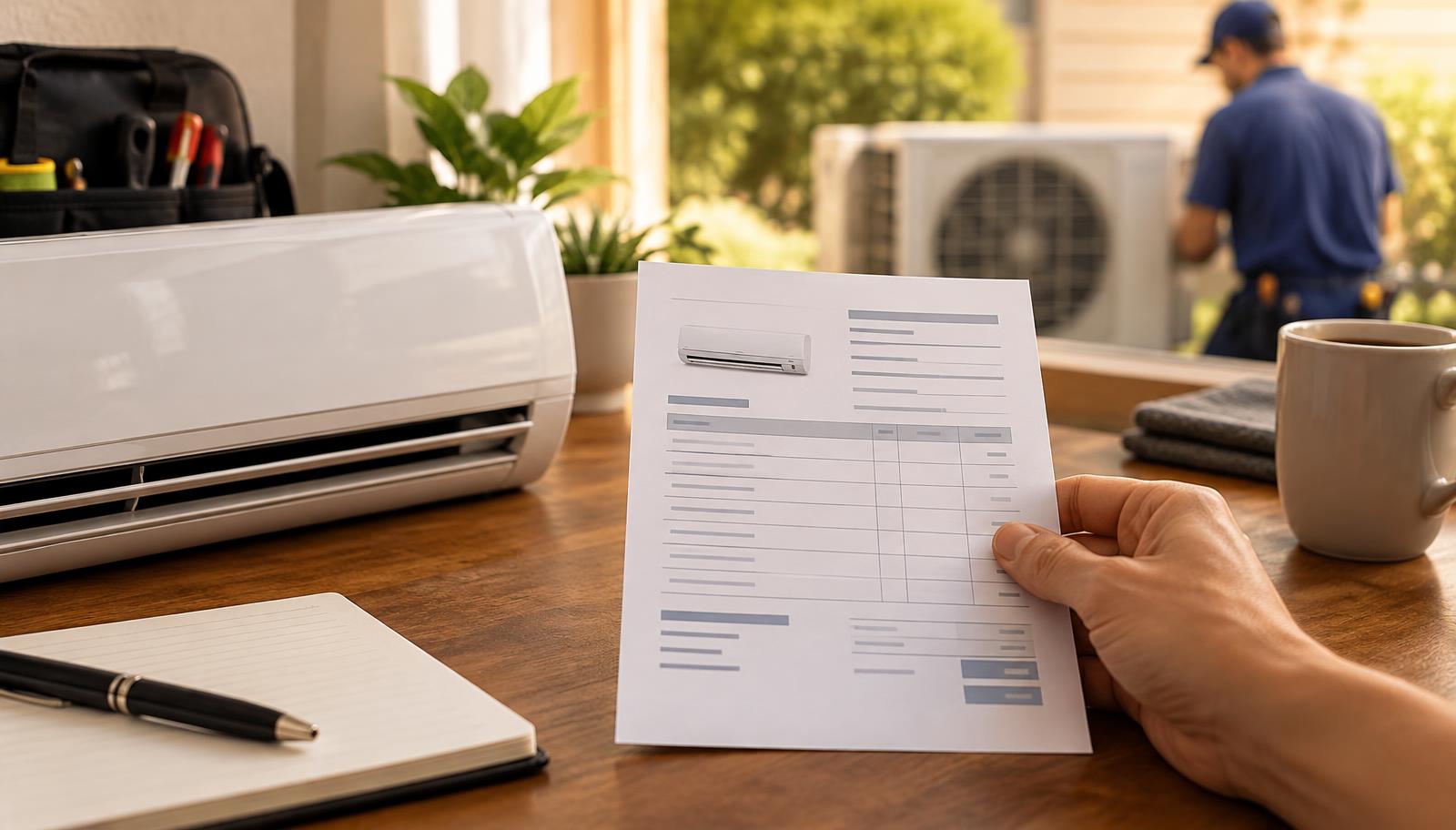
Air Conditioner Receipt: What to Include and How to Create One
An air conditioner receipt is the document you give a customer after payment for an AC repair, maintenance visit, replacement part, or installation. It should identify the customer and job, list what was paid for, show the amount paid and payment method, and include a unique receipt number and date.
A clear receipt helps the customer track the work and gives your HVAC business a consistent payment record. Keep the wording factual: record the work completed and the payment received rather than making broad performance claims.
Receipt, invoice, and estimate serve different purposes
Use the document that matches the stage of the job:
- Estimate or quote: A proposed scope and price before approval.
- Work order or service report: Details of inspection, diagnosis, work performed, and technician notes.
- Invoice: An amount due or a request for payment. It may be marked paid once payment is collected.
- Receipt: Confirmation that a specified payment was received.
An invoice marked “Paid” can work as a receipt if it clearly shows the payment date, amount, method, and remaining balance. A separate receipt is useful when a customer pays a deposit, makes a partial payment, or asks for a simple proof-of-payment document.
Required information for an air conditioner receipt
A usable AC receipt should let someone understand the transaction without searching through messages or dispatch notes. Include the following.
Your business details
- Business name
- Business address, phone number, and email or website
- Tax or registration information if it applies to your business and location
Receipt and customer details
- Receipt number
- Receipt issue date
- Customer name
- Service address, when different from the billing address
- Related invoice, work order, or job number
Using a unique receipt number prevents confusion when a customer calls with a question or submits the receipt for reimbursement.
Description of the AC work or items
Describe the completed work plainly. The detail should be enough to identify the service without turning the receipt into a full technician report.
Examples:
- Diagnostic visit for upstairs air conditioning system
- Condensate drain line clearing
- Replacement of customer-approved capacitor
- Seasonal air conditioner maintenance
- Installation of air conditioning equipment as listed on invoice 1048
- Deposit received for approved air conditioner replacement
For a part sale or replacement, include the part description and quantity. If the receipt is for a full equipment installation, reference the proposal or invoice that contains the complete equipment and scope details.
Payment summary
Show the numbers in a simple sequence:
- Subtotal
- Any tax or separately stated charge, where applicable
- Total amount
- Amount paid on this transaction
- Balance due, if any
- Payment method
- Payment date
If payment is partial, say so directly. For example: “Payment received: $500.00. Remaining balance: $1,250.00.” Do not label a receipt “Paid in Full” unless the balance is actually zero.
Payment confirmation
Add a short confirmation such as:
Payment of $[amount] received on [date] by [payment method].
For card, ACH, or check payments, consider showing only a non-sensitive reference, such as the last four digits, check number, or transaction reference. Never place full card numbers or bank-account details on a customer receipt.
Air conditioner receipt template
Copy this format into your invoicing system, spreadsheet, or document template. Replace bracketed text before sending.
[BUSINESS NAME]
[Business address]
[Phone] | [Email] | [Website]

RECEIPT
Receipt #: [Receipt number]
Receipt date: [Date]
Related invoice/work order #: [Number]

Received from:
[Customer name]
[Billing address]

Service address:
[Service address]

Description                                      Amount
[AC service, repair, maintenance, part, or deposit]  $[amount]
[Additional line item, if needed]                    $[amount]

Subtotal:                                         $[amount]
[Tax or other separately stated charge]:          $[amount]
Total:                                            $[amount]
Payment received:                                 $[amount]
Balance due:                                      $[amount]

Payment method: [Cash / check / card / ACH / other]
Payment date: [Date]
Payment reference: [Optional non-sensitive reference]

Payment of $[amount] received on [date].

Thank you,
[Business name]
Examples for common HVAC transactions
The receipt needs to reflect the actual transaction. These examples show the level of detail to aim for.
AC repair receipt
Use a repair-oriented description when the customer has paid for a completed service call.
Description: Air conditioner diagnostic visit and replacement of customer-approved run capacitor.
Payment received: $[amount]
Balance due: $0.00
Payment method: [method]
If diagnostic findings are important, place them in the service report or work order and reference that document from the receipt.
Air conditioner maintenance receipt
For a maintenance visit, record the completed visit and any separately billed items.
Description: Seasonal air conditioner maintenance visit.
Description: Replacement air filter supplied and installed.
Avoid vague entries such as “AC work” when the customer may need to identify the visit later.
AC installation deposit receipt
A deposit receipt should make the payment status unambiguous.
Description: Deposit received for approved air conditioner installation.
Related proposal: [proposal number]
Total approved amount: $[amount]
Deposit received today: $[amount]
Remaining balance: $[amount]
The receipt confirms money received; the signed proposal or contract should carry the agreed scope, equipment selection, schedule, and other project terms.
Final payment receipt for an installation
When collecting the last payment, reference the project records and show that the account is settled only when it is.
Description: Final payment for air conditioner installation per invoice [number].
Payment received: $[amount]
Balance due: $0.00
Status: Paid in full
A practical workflow for issuing receipts
Issue the receipt as soon as the payment is confirmed, then store it with the related job records. A consistent workflow reduces duplicate receipts and makes customer questions easier to resolve.
- Confirm the payment. Verify the amount, date, and payment method before marking the invoice paid.
- Apply the payment to the correct job or invoice. This is especially important for repeat customers or multi-system projects.
- Create the receipt with a unique number. Use a sequence that your office can search later.
- Show the post-payment balance. The customer should not have to calculate whether anything remains due.
- Send a customer copy. Email is usually easiest, but provide a printed copy when requested or when your process calls for it.
- Save the business copy with supporting records. Keep the receipt, invoice, payment confirmation, work order, and approved estimate together where possible.
The IRS advises businesses to keep records supporting income and expenses, including documents that explain a transaction. Review its small-business recordkeeping guidance and consult a qualified tax professional for record-retention practices that apply to your business.
How to handle a request for a duplicate receipt
Customers may need another copy for a landlord, property manager, warranty file, insurer, or personal records. Reissue the original transaction rather than creating a new payment event.
Use the original receipt number and payment details, then label the document clearly:
Duplicate copy — originally issued [original date].
Do not change the original payment date or make a new receipt number merely because the customer requested another copy. If you must correct an error, retain an internal note explaining the correction and provide a revised document that identifies what changed.
Common air conditioner receipt mistakes
Calling an unpaid invoice a receipt
A receipt means payment was received. If no payment has been collected, send an invoice or estimate instead.
Omitting the service address
The billing address may not identify the property where the air conditioner was serviced. Include the service location when it differs from the customer’s billing address.
Using descriptions that are too broad
“HVAC service” may not help a customer identify the transaction later. A short, specific description is better: “AC diagnostic visit” or “condensate drain line clearing.”
Losing track of deposits and partial payments
For every payment, show the amount received and the remaining balance. This prevents a deposit receipt from being mistaken for proof that the entire installation was paid.
Including sensitive payment data
A receipt should confirm payment, not expose financial information. Limit payment references to non-sensitive identifiers.
Making guarantees on the receipt
Keep warranty, return, cancellation, and project terms in the appropriate agreement or policy document. If relevant, the receipt can reference that document rather than attempting to summarize it.
Final check before sending
Before delivering an air conditioner receipt, verify that it answers five questions:
- Who made the payment?
- Which AC job, part, or project does it relate to?
- How much was received?
- When and how was it paid?
- Is there any balance left?
If the receipt answers those questions clearly, it will be useful to the customer and easier for your office to retrieve later.